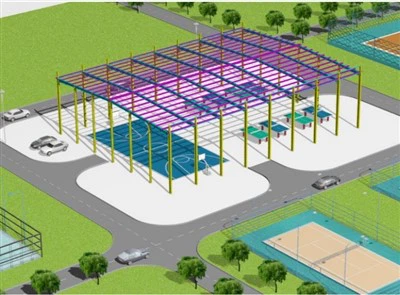
Hey there! I'm a supplier of Modern Steel Frame Buildings, and today I want to dig into a super important question: Can modern steel frame buildings withstand heavy equipment loads in industrial settings?
Let's start by understanding what modern steel frame buildings are all about. These buildings are constructed using a framework of steel beams and columns. Steel is an amazing material. It's strong, durable, and can be fabricated into various shapes and sizes. This flexibility allows architects and engineers to design buildings that meet specific needs, whether it's a small workshop or a large industrial complex.
In industrial settings, heavy equipment is the norm. We're talking about things like large machinery, cranes, and storage racks filled with tons of goods. These loads can put a serious strain on a building's structure. So, can modern steel frame buildings handle it? The short answer is yes, but let's break it down further.
Strength and Durability of Steel
Steel has an incredibly high strength - to - weight ratio. This means that it can support a large amount of weight without being overly heavy itself. When engineers design a steel frame building for an industrial setting, they calculate the expected loads based on the type of equipment that will be used inside. They then select the appropriate steel members with the right strength and dimensions to handle those loads.
For example, in a manufacturing plant where large stamping machines are used, the steel columns and beams are designed to withstand the dynamic loads generated by the machines' operation. These loads can include vibrations, impacts, and static weights. Steel's ability to absorb and distribute these forces makes it an ideal choice for such applications.
Design and Engineering Considerations
The design of a modern steel frame building is crucial when it comes to withstanding heavy equipment loads. Engineers use advanced software to model the building and simulate different load scenarios. They consider factors like the location of the equipment, the frequency of its use, and the potential for overload.
In a multi - level industrial building, like a Multi Storey Steel Structure Building, the design becomes even more complex. The weight of the equipment on upper floors needs to be transferred safely to the foundation through the steel frame. This requires careful planning of the column layout, beam sizes, and connection details.
Connections between steel members are also a critical aspect. Welded and bolted connections are commonly used to ensure that the steel frame acts as a single, cohesive unit. These connections are designed to transfer loads efficiently and prevent any weak points in the structure.
Case Studies
Let's look at some real - world examples. There are numerous industrial facilities around the world that rely on modern steel frame buildings to house heavy equipment. In a large automotive manufacturing plant, steel frame buildings support the weight of assembly lines, robotic arms, and large storage areas for parts. These buildings have been in operation for decades, withstanding the constant stress of heavy machinery.
Another example is a warehouse that stores heavy pallets of goods. The steel frame structure is designed to support the weight of the pallets stacked several levels high. The use of steel allows for large open spaces without the need for excessive columns, which is ideal for efficient storage and movement of goods.
Advantages over Other Building Materials
Compared to other building materials like concrete or wood, steel has several advantages when it comes to handling heavy equipment loads. Concrete is heavy and less flexible, which can make it more difficult to design for dynamic loads. Wood, on the other hand, has a lower strength - to - weight ratio and is more susceptible to damage from moisture, pests, and fire.
Steel is also more resistant to corrosion when properly treated. In industrial settings where there may be exposure to chemicals or moisture, this is a significant advantage. It ensures the long - term integrity of the building and reduces the need for frequent maintenance.
Prefabrication and Construction Efficiency
Many modern steel frame buildings, including Prefab Steel Commercial Buildings Residential, are prefabricated. This means that the steel components are manufactured off - site in a controlled environment and then assembled on - site. This process not only speeds up the construction time but also ensures a higher quality of workmanship.
During the prefabrication process, the steel members are precisely fabricated to the required specifications. This accuracy is essential when it comes to ensuring that the building can withstand heavy equipment loads. When the components are assembled on - site, they fit together perfectly, creating a strong and stable structure.
Maintenance and Long - Term Performance
Maintaining a modern steel frame building in an industrial setting is relatively straightforward. Regular inspections are carried out to check for any signs of corrosion, damage to the connections, or deformation of the steel members. If any issues are detected, they can be addressed quickly to prevent further damage.
The long - term performance of a steel frame building is also excellent. With proper maintenance, a steel frame building can last for decades, even under the constant stress of heavy equipment loads. This makes it a cost - effective solution for industrial businesses in the long run.
Limitations and Challenges
While modern steel frame buildings are well - suited for heavy equipment loads, there are some limitations and challenges. One of the main challenges is the potential for corrosion in harsh environments. If the steel is not properly protected, it can rust over time, which can weaken the structure.
Another challenge is the need for accurate load calculations. If the loads are underestimated during the design phase, it can lead to structural problems in the future. This is why it's so important to work with experienced engineers and designers who understand the specific requirements of industrial applications.
Conclusion
In conclusion, modern steel frame buildings are more than capable of withstanding heavy equipment loads in industrial settings. Their strength, durability, and the ability to be precisely designed make them an ideal choice for industrial applications. Whether it's a single - storey warehouse or a multi - level manufacturing plant, steel frame buildings can provide a safe and reliable solution.


If you're in the market for an industrial building that can handle heavy equipment, I encourage you to consider modern steel frame buildings. We, as a supplier, have the expertise and experience to help you design and build a structure that meets your specific needs. Contact us to start a conversation about your project and see how we can work together to create the perfect industrial building for you.
References
- "Steel Construction Manual", American Institute of Steel Construction
- "Design of Steel Structures", S. K. Duggal
- Case studies from various industrial steel frame building projects