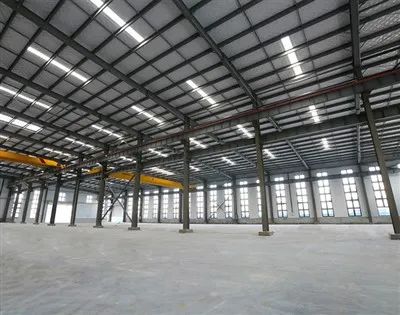
In recent years, prefabricated steel buildings have gained significant popularity due to their numerous advantages, including cost - effectiveness, rapid construction, and environmental friendliness. As a supplier of prefabricated steel buildings, one question that frequently arises from our clients is whether these structures can withstand earthquakes. In this blog post, I will delve into the scientific aspects of this issue and provide a comprehensive answer.
The Basics of Earthquake Resistance
Earthquakes generate seismic waves that cause the ground to shake. The impact of an earthquake on a building depends on several factors, such as the magnitude of the earthquake, the distance from the epicenter, the local soil conditions, and the design and construction of the building itself.
When an earthquake occurs, buildings are subjected to lateral forces that can cause them to sway, tilt, or even collapse. To withstand these forces, a building needs to have a certain level of strength, stiffness, and ductility. Strength refers to the ability of the building to resist the applied forces without breaking. Stiffness is the building's resistance to deformation, while ductility is the ability to deform without losing its load - carrying capacity.
Advantages of Prefabricated Steel Buildings in Earthquake Resistance
High Strength - to - Weight Ratio
Steel is known for its high strength - to - weight ratio. Compared to traditional building materials like concrete and masonry, steel can provide the same level of strength with less weight. This is a significant advantage in earthquake - prone areas because lighter buildings experience smaller inertial forces during an earthquake. According to Newton's second law of motion (F = ma), where F is the force, m is the mass, and a is the acceleration, a lighter building (lower m) will experience a smaller force when subjected to the same acceleration caused by an earthquake.
Ductility
One of the most important properties of steel in earthquake resistance is its ductility. Steel can undergo large plastic deformations before failure. When an earthquake occurs, the lateral forces cause the building to deform. In a steel building, the steel members can absorb and dissipate the energy of the seismic waves through plastic deformation, rather than brittle failure. This allows the building to withstand the earthquake without collapsing. For example, during a moderate - to - strong earthquake, the steel frames of a prefabricated steel building can bend and flex, gradually dissipating the seismic energy over time.
Precise Manufacturing and Quality Control
Prefabricated steel buildings are manufactured in a controlled factory environment. This allows for precise manufacturing and strict quality control. The steel components are fabricated to exact specifications, ensuring that the building has consistent structural performance. In contrast, on - site construction of traditional buildings may be subject to human errors and variations in construction quality, which can affect the building's earthquake resistance.
Design Considerations for Earthquake - Resistant Prefabricated Steel Buildings
Structural Design
Proper structural design is crucial for ensuring the earthquake resistance of prefabricated steel buildings. Engineers use advanced computer - aided design (CAD) and finite element analysis (FEA) software to simulate the behavior of the building under seismic loads. They design the steel frames, connections, and bracing systems to resist the expected lateral forces. For example, moment - resisting frames can be used to provide lateral stability. These frames have rigid connections between the beams and columns, which can resist both vertical and horizontal loads.
Foundation Design
The foundation of a prefabricated steel building is also critical in earthquake resistance. The foundation must be designed to transfer the loads from the building to the ground safely. In earthquake - prone areas, deep foundations such as piles or caissons may be used to reach more stable soil layers. The foundation should also be designed to resist the uplift and sliding forces caused by earthquakes.


Connection Design
The connections between the steel components play a vital role in the overall performance of the building during an earthquake. Welded and bolted connections are commonly used in prefabricated steel buildings. Welded connections provide high strength and stiffness, while bolted connections allow for easier assembly and disassembly. However, the design of these connections must ensure that they can transfer the loads effectively and maintain their integrity during seismic events.
Case Studies
There have been many real - world examples that demonstrate the earthquake - resistant capabilities of prefabricated steel buildings. In Japan, a country known for its high seismic activity, many prefabricated steel buildings have withstood major earthquakes. For instance, during the 2011 Tohoku earthquake, some prefabricated steel industrial buildings and warehouses in the affected areas remained standing, while nearby traditional buildings suffered significant damage.
Another example is in California, USA. With its frequent seismic activity, many new construction projects, including Prefabricated Metal Warehouse and Prefabricated Steel Buildings As Modular Warehouse, are increasingly using prefabricated steel construction. These buildings have been designed to meet the strict seismic design codes in the region and have shown good performance in small - to - moderate earthquakes.
Limitations and Challenges
Although prefabricated steel buildings have many advantages in earthquake resistance, there are also some limitations and challenges.
Corrosion
Steel is susceptible to corrosion, especially in humid or coastal environments. Corrosion can reduce the strength and ductility of the steel members over time, which may affect the building's earthquake resistance. To prevent corrosion, proper surface treatment and coating are required during the manufacturing process. Regular inspection and maintenance are also necessary to ensure the long - term performance of the building.
Fire Resistance
Steel loses its strength at high temperatures. In the event of a fire during or after an earthquake, the steel structure may be weakened. Therefore, fire - resistant coatings or insulation materials need to be applied to the steel members to protect them from fire.
Conclusion
In conclusion, prefabricated steel buildings have significant advantages in earthquake resistance due to their high strength - to - weight ratio, ductility, and precise manufacturing. With proper design and construction, these buildings can withstand earthquakes effectively. However, it is important to address the limitations such as corrosion and fire resistance through appropriate measures.
As a supplier of Prefabricated Steel Buildings, we are committed to providing high - quality earthquake - resistant prefabricated steel buildings. Our team of experienced engineers and designers uses the latest technology and design principles to ensure that our buildings meet the highest standards of seismic safety.
If you are considering building a structure in an earthquake - prone area, we encourage you to contact us for more information. Our experts can provide you with detailed solutions tailored to your specific needs. Whether it's a small - scale industrial building or a large - scale modular warehouse, we have the expertise and resources to deliver a reliable and earthquake - resistant prefabricated steel building. Let's start a conversation about your project today!
References
- Bruneau, M., Reinhorn, A. M., & Mahin, S. A. (2015). Ductility and energy dissipation in earthquake - resistant structures. CRC Press.
- American Institute of Steel Construction (AISC). (2016). Seismic provisions for structural steel buildings.
- FEMA P - 750. (2009). NEHRP recommended seismic design provisions for new buildings and other structures.